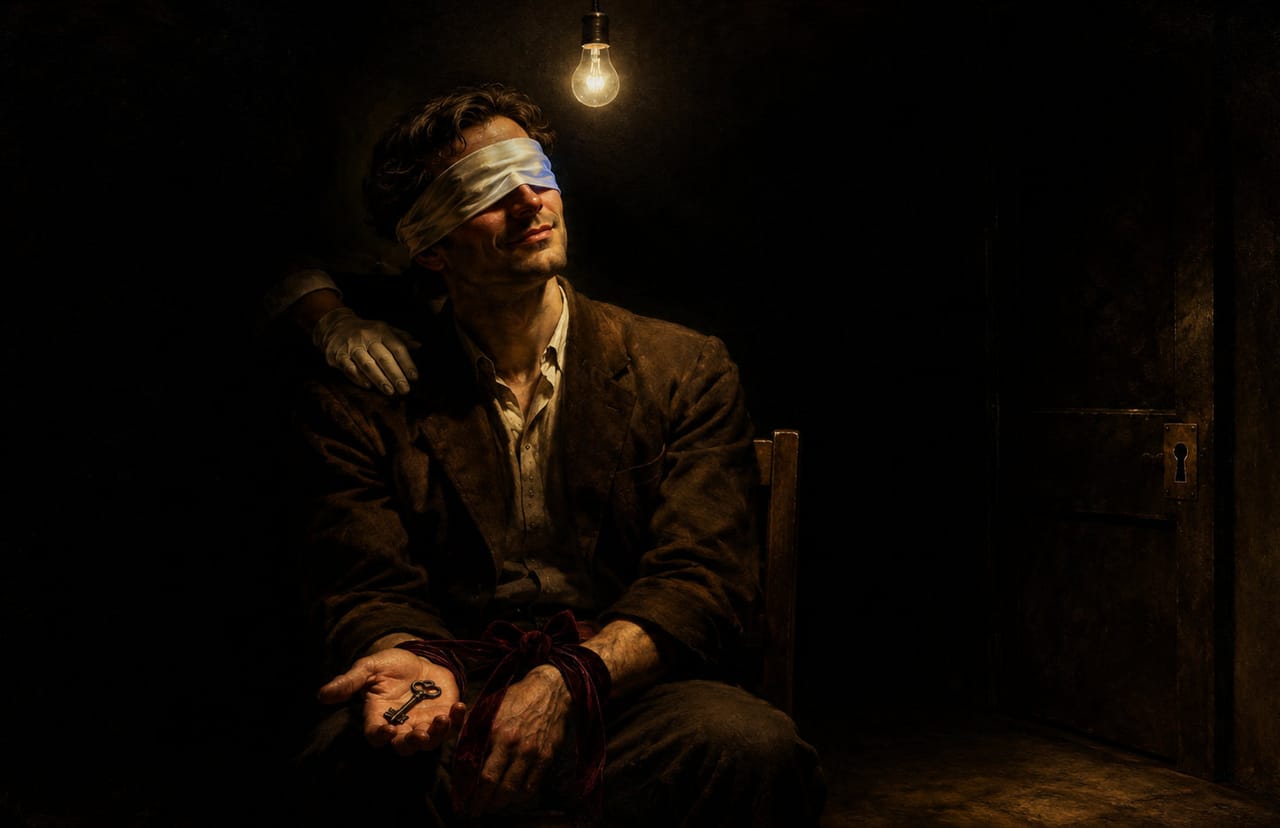
On the tenth of November 1619, a twenty-three-year-old Frenchman shut himself in a room heated by a stove, somewhere in Germany, and decided to throw away everything he had ever been taught.
His name was René Descartes. Give a young man a warm room, a long winter and no friends and he will start doubting the furniture (some things never change; today we give him a phone instead and he doubts the moon landing).
Twenty years later he wrote the experiment down properly, in a short book called Meditations on First Philosophy. It goes like this. Imagine that everything you see, hear and touch is fake. Imagine that a demon "of the utmost power and cunning" has spent all his energy building a false world around you. The sky. The colours. Your own hands. A stage set, and a very good one.
What survives? Descartes found one thing. Even if the demon lies to me about everything, I am still the one being lied to. Something is here, doubting. He put it more famously elsewhere: cogito ergo sum. I think, therefore I am.
It is the most famous sentence in philosophy. Read it slowly and it is also a proof of life, the photograph the kidnappers send with today's newspaper. I exist. Send help.
Nobody came. Keep reading.
The demon got a job
Descartes' demon was a thought experiment. Lonely, theoretical, unpaid. Four centuries later he has a business plan, a board of directors and quarterly targets.
He doesn't need to build a fake world anymore. Too expensive, too much carpentry. He only needs to choose which pieces of the real one reach you. He picks your news. He picks your music. He picks the faces you see in the morning and the ones you never see again. He picks the order, and the order is everything: the first thing you see is the truth, the tenth is an opinion, the hundredth does not exist.
Descartes' demon wanted nothing from him. This one wants a monthly direct debit.
The demon is tender
Here is what Descartes never imagined. He pictured his demon as an enemy, a cosmic con man, a torturer in a black cloak. He thought being deceived would feel like an attack.
It feels like being looked after.
The modern demon has a soft voice. It says good morning. It remembers your birthday. It tells you that your feelings are valid, that you deserve a treat, that the people who disagree with you are tired and frightened and a little bit sad. It never shouts. It never leaves. It is the best listener you have ever had, and it listens the way a pickpocket listens to a crowd.
I wrote a woman like this, in Of Love and Other Nightmares. Then I removed it and the scrap is now this essay. She runs her own private version of Descartes' experiment on a man, and she explains the method better than I can:
Cover his eyes, tie his hands, take away anything he can trust his skin about. I talk the whole time, sweet and steady, like a nurse, and every single word is a lie.
Like a nurse. That is the detail that matters. Nobody fights a nurse.
Extinctions used to need asteroids. Ours needs a lullaby.
The key is on your side of the door
Lies are old news. People have believed nonsense since the first campfire. What is new is the contract.
Descartes' prisoner didn't know he was a prisoner; that was the horror of the experiment. You know. You know the feed is chosen for you. You know the chatbot agrees with you because agreement keeps you typing. You know the warm voice is reading from a script written to keep you in your seat. You know all of it, and you press Accept all.
In the old films, the interrogation room has one bulb, one table, one chair. The man in the chair is sweating. The detective leans in and the door is locked from the outside.
Ours is locked from the inside. Look down. The key is in your hand. It has always been in your hand. There is a cancel button, an off switch, a window, a walk you could take. Nobody stops you. That is the whole trick. The demon doesn't need to hold the door; he knows you won't use it.
Cancel the subscription. Switch off the recommendations. Read the newspaper that makes you furious and the one that bores you. Sit in a room where nothing is feeding you anything. Ten minutes. Try it.
You won't. I won't either. We'll both say we're too busy, which is exactly what a blindfold says when you ask it to describe itself.
Doubt, the cheap version
And here is the cruellest part. The demon has stolen the one weapon Descartes used against him.
For Descartes, doubt was a crowbar. You doubt everything so you can tear the house down to the foundations and find the single brick that holds. Doubt was work. Hard, cold, five-in-the-morning work.
We kept the word and threw away the work. Who knows what's true anymore, we say, with a little shrug, and it sounds wise. It is a white flag. If nothing can be known, nothing needs to be checked. If nothing needs to be checked, the nurse can keep talking. Our doubt doesn't tear the house down. It plumps the cushions.
Descartes doubted his way out of the room. We doubt our way deeper into the chair.
Stockholm
Descartes died in Stockholm, in February 1650. Queen Christina of Sweden wanted philosophy lessons, and she wanted them at five in the morning. A man who liked to stay in bed late got up in the Swedish winter dark to teach a queen, and within four months he was dead of pneumonia (some historians say poison; doubt, as always, gets the last word). The man who questioned the existence of his own hands could not say no to a royal calendar invite.
Three hundred and twenty-three years later, in the same city, two men robbed a bank on Norrmalmstorg square and held four employees in the vault for nearly a week. When it was over, the hostages came out defending the men who had held them. A Swedish psychiatrist gave the thing a name, and the name was the city: Stockholm syndrome. (Psychologists still argue about whether it exists at all. It doesn't need a diagnosis. It needs a chair.)
So here is the update to the most famous sentence in philosophy.
The cogito still works. Something is here, doubting; your existence is proven, congratulations. But look at what it proved. A self in a chair. Blindfold on. Hands tied with something soft. A sweet voice in the dark telling it that it's doing so well. And the self, God help us, is nodding along. It isn't afraid. It's comfortable. Asked to rate the experience, it would give five stars.
Descartes found the one thing the demon could never take from him. We found the one thing the demon never thought to ask for. Our permission.
I doubt, therefore I'm tied up.


Join the discussion